
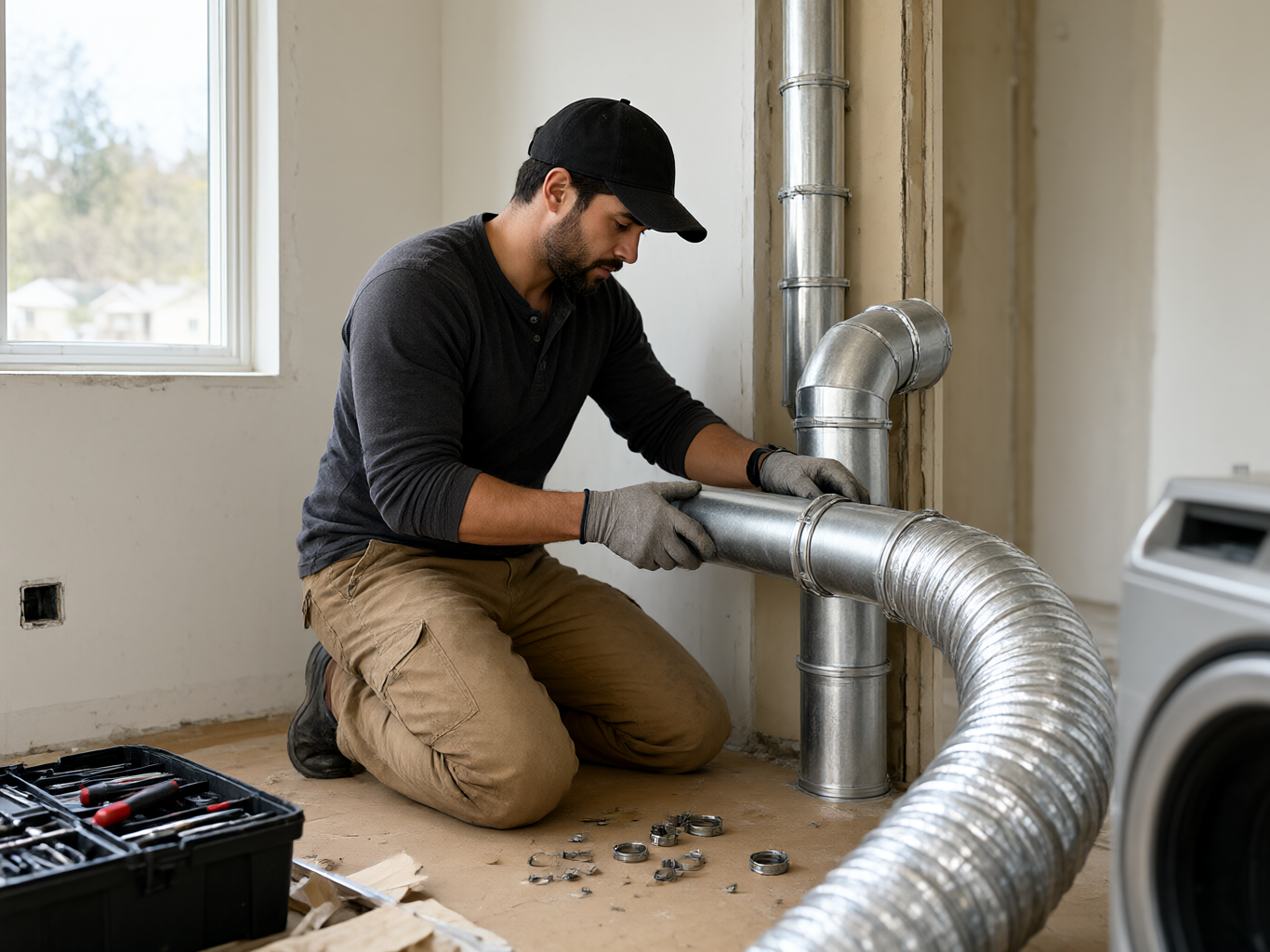
Replacing a dryer vent is not just swapping out a flexible hose. We pull out collapsed foil, crushed semi-rigid aluminum, or outdated vinyl that code no longer permits, then install smooth-wall rigid aluminum with sealed joints and foil tape. Rerouting means recalculating developed length, limiting elbows, and moving the termination point to an exterior wall with a proper damper cap. On gas dryers, we verify combustion air and clearance so exhaust cannot backdraft into the laundry room. Every joint is inspected because a single loose seam leaks lint and moisture into Smith County framing.
Tyler’s humid subtropical climate, with hot summers and mild winters, means laundry rooms run year-round and trapped moisture lingers in ductwork longer than in drier regions. Older housing stock in Downtown Tyler and the Azalea District often has original metal ducting that has corroded at wall penetrations or been patched with flexible vinyl that sags and collects lint. In Charnwood and Hollytree, newer builds frequently route vents through long attic chases where summer heat bakes the duct and accelerates seal failure. We match the replacement material to the home’s age and layout rather than using a one-size-fits-all fix.
Rerouting a dryer vent often starts because the original exit is blocked by an addition, a fence, or landscaping near the Tyler Municipal Rose Garden or Caldwell Zoo side of a property. We run new rigid pipe through floor joists or crawl spaces, avoiding sharp bends that reduce static pressure and extend drying time. Termination caps are placed at least twelve inches above grade and away from air-conditioning condensers so lint does not recirculate into the unit. We never terminate into a crawl space, attic, or garage, which creates a moisture and fire hazard in Smith County homes.
After installation we test airflow at the exterior cap and inside the laundry room to confirm the blower can push lint through the new run. We check that no screws protrude into the duct interior, where they catch lint and create a blockage point. The old ducting is removed and the work area is cleaned so no debris is left behind. As an owner-operated team serving whitehouse, lindale, and across Tyler, we provide upfront quotes before cutting any drywall or roofing, and our workmanship is something you can inspect before we finish.
How this page differs
This page covers replacing or rerouting a whole existing vent run. It is different from New Dryer Vent Installation, which creates a vent where none existed, and from repair, which fixes only part of a run. Replacement is the choice when the duct material, route, or termination itself is the problem. Available in Tyler, Lindale, Whitehouse, and Bullard, Texas.
Technician insight
In Tyler, the thing that catches most people out with dryer vent replacement and rerouting is the old flexible vinyl still running behind washers in older Downtown Tyler and Azalea District homes. Homeowners assume a new hose fixes everything, but the real problem is usually a long, sagging run through a humid attic where lint sticks to moisture and the dryer overheats. I always check the full path to the exterior cap, not just the connection behind the machine.
Blocked Wall Cap in a Hollytree Ranch Home
A homeowner in Hollytree reported clothes taking two cycles to dry. We found the original rigid duct had separated at a wall penetration and was dumping lint into the crawl space instead of outside. We rerouted the run through the floor joists to a new dampered cap on the exterior wall, and the dryer now exhausts freely on the first cycle.
Dryer Vent Replacement & Rerouting Services We Offer
✓Rigid Aluminum Duct Replacement
Swapping collapsed foil or prohibited vinyl for smooth-wall rigid aluminum that resists lint buildup and meets modern fire-safety expectations in Tyler homes.
✓Exterior Wall Vent Rerouting
Moving the termination point to a new exterior wall when additions or fences block the original exit, with proper damper cap installation to stop backdrafts.
✓Long-Run Booster Vent Installation
Adding in-line booster airflow for extended runs common in Hollytree and Charnwood layouts, helping the dryer push lint farther without overworking the motor.
✓Second-Story Laundry Vent Relocation
Rerouting vents from upstairs laundry closets through joists to an exterior termination, reducing drying time and moisture buildup in humid Tyler summers.
✓Dryer Vent Termination Cap Replacement
Replacing missing, stuck, or pest-damaged exterior caps so exhaust exits freely and outside air cannot enter the duct when the dryer is off.
✓Flexible Transition Duct Upgrade
Replacing the short flexible connector behind the dryer with UL-listed semi-rigid metal that won’t kink or crush against the wall in tight Tyler laundry closets.
How it works
- 1
Site Evaluation and Airflow Test
We measure existing static pressure, inspect the current termination, and identify obstructions such as blocked wall caps or collapsed ducting before recommending replacement or rerouting.
- 2
Material Selection and Route Planning
Based on home age and layout in Downtown Tyler, the Azalea District, or newer subdivisions, we select rigid aluminum or semi-rigid metal and map the shortest compliant path to the exterior.
- 3
Removal and New Duct Installation
Old vinyl or deteriorated metal is removed, joints are sealed with foil tape, and the new run is secured without screws protruding into the airflow path.
- 4
Termination Cap and Final Test
A dampered cap is mounted at the correct height and clearance, then we run the dryer to verify exhaust exits freely and no lint escapes at joints.
Pricing
Pricing depends on duct length, material type, access difficulty, number of elbows, and whether we must cut through framing or exterior siding. Longer runs in older Smith County homes typically require more labor and materials.