
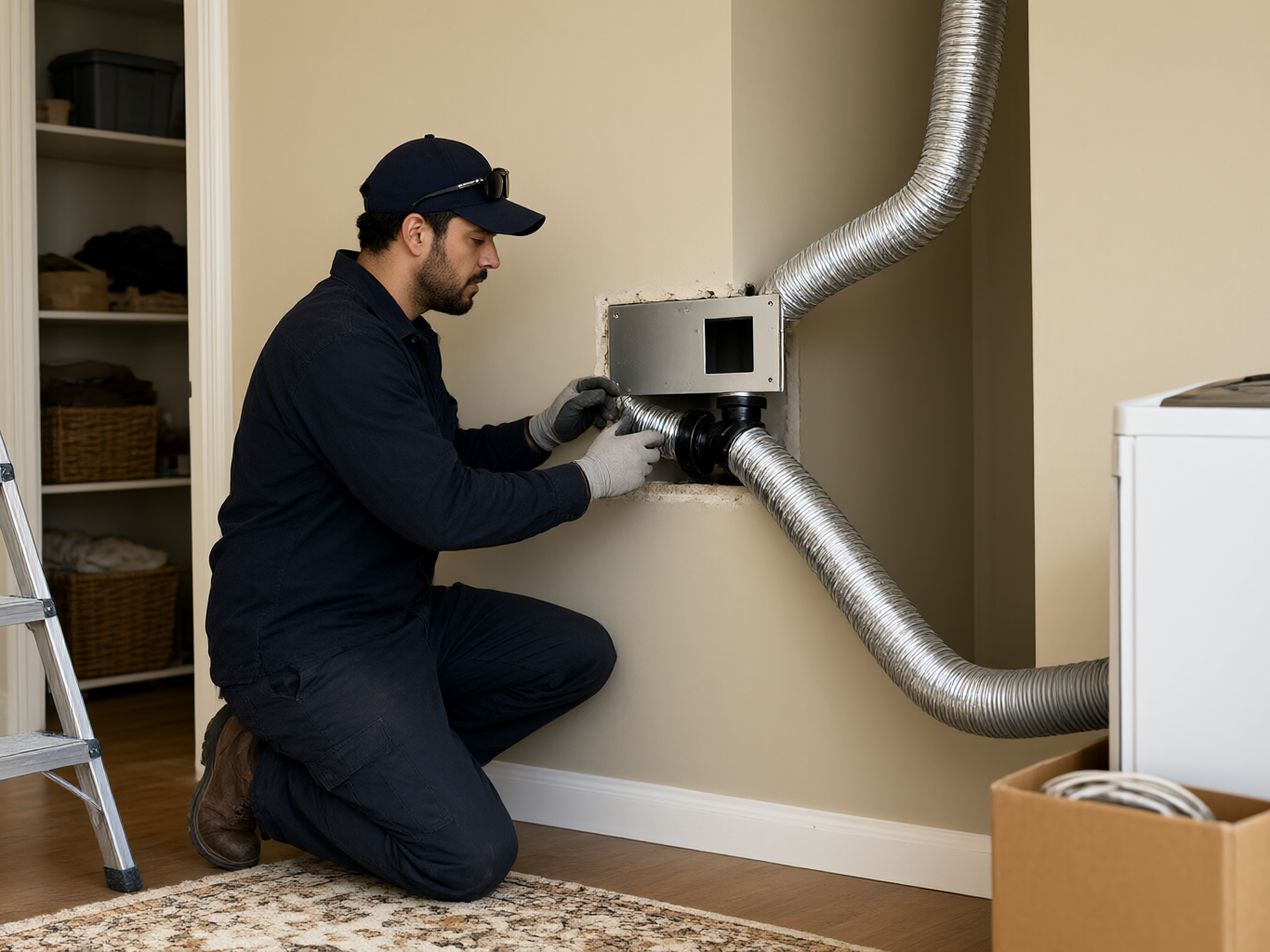
A new dryer vent installation starts with the duct material, and I never use flexible vinyl or foil because they sag, trap lint, and restrict airflow. I run smooth-wall rigid metal—typically four-inch galvanized steel or aluminum—sealed with UL-listed foil tape rather than sheet-metal screws, which create ledges where lint collects. The run must terminate outdoors with a backdraft-damper cap, never into an attic, crawlspace, or garage, and total developed length stays within the dryer manufacturer’s limit so the blower can push moist air outside efficiently.
Tyler’s humid subtropical climate means hot summers and mild winters, so a vent that passes through an unconditioned attic can sweat during temperature swings, and that moisture meets lint to create a stubborn blockage. Older housing stock in Downtown Tyler and the Azalea District often has plaster walls and narrow laundry closets, which makes routing a straight metal run harder than it looks in new construction. Whether the property sits near the Tyler Museum of Art or out toward Caldwell Zoo, wall materials and access dictate the path. Homes in Charnwood and Hollytree tend to have tighter second-floor laundry spaces, while properties out toward Whitehouse and Lindale sometimes need longer runs to reach an exterior wall.
Safety is the part homeowners overlook most often. A gas dryer needs a properly sealed connection and a vent that cannot back up combustion gases, while an electric dryer still moves enough heat and moisture to ignite accumulated lint if the duct is crushed or kinked behind the machine. I also check that the termination cap opens freely and that the wall or roof flashing seals against Smith County rain, because a poorly flashed vent can rot framing and invite mold long before the dryer ever stops working.
How this page differs
This page is about a brand-new vent run, for example when a dryer moves to a new room or a home has no vent at all. It is different from Dryer Vent Replacement & Rerouting, which swaps an existing run, and from repair, which fixes part of an existing run. Installation plans the full route, duct material, and termination from the start. Installation is available in Tyler, Lindale, Whitehouse, and Flint, Texas.
Technician insight
In Tyler, the thing that catches most people out with new dryer vent installation is assuming a short flexible hose behind the dryer is enough. In older neighborhoods like Downtown Tyler and the Azalea District, plaster walls and tight closets force longer metal runs through attics, and our humid subtropical climate turns any sag in the duct into a lint and moisture trap.
Second-Floor Laundry Vent in Hollytree
A homeowner in Hollytree bought a new dryer but had no exterior vent path from the upstairs laundry closet. We found the only compliant route ran through a closet ceiling and out a rear wall, so we installed rigid metal duct with a flashed termination cap and tested airflow at the cap. The dryer now exhausts fully on the first cycle, and the homeowner no longer finds damp clothes after a timed dry.
New Dryer Vent Installation Services We Offer
✓Rigid Metal Duct Routing and Installation
Smooth-wall galvanized or aluminum ducting runs straight from the dryer to the exterior, reducing lint buildup and shortening drying times compared with flexible foil or vinyl.
✓Exterior Termination Cap Installation
A backdraft-damper cap mounted on an outside wall or roof keeps moist air out and pests from entering, which matters during Tyler’s humid summers.
✓Laundry Room Vent Path Assessment
I map the shortest compliant route through closets, walls, or attics, accounting for older plaster construction in Downtown Tyler and the Azalea District.
✓Gas Dryer Vent Connection and Safety Check
Sealed metal connections and proper termination protect against combustion-gas buildup while ensuring the dryer exhausts efficiently.
✓Multi-Story Vent Run Installation
Longer vertical runs through second-floor laundry closets in Charnwood and Hollytree are sized and supported so the blower can maintain airflow.
✓Vinyl Flex Duct Replacement with Metal
Collapsed or sagging flexible duct is removed and replaced with rigid metal, eliminating the low spots where lint and moisture collect.
How it works
- 1
Site Evaluation and Vent Path Mapping
I inspect the laundry location, measure the route to the exterior, and identify obstacles such as wall studs, joists, or finished plaster common in older Tyler homes.
- 2
Material Selection and Code-Compliant Layout
I choose rigid metal ducting and termination hardware that meet residential exhaust standards, then lay out the run to minimize elbows and total developed length.
- 3
Duct Fabrication, Sealing, and Termination
Sections are cut and joined with foil tape and clamps, the exterior cap is flashed against rain, and the dryer is reconnected and leveled.
- 4
Airflow Test and Final Inspection
I run the dryer, measure exhaust flow at the termination cap, confirm the damper opens freely, and clean up all debris before leaving.
Pricing
Cost depends on linear footage of duct, the number of elbows, whether the termination goes through a wall or roof, and if finished walls must be opened and patched. Long runs to exterior walls in Whitehouse or Lindale, and second-floor laundry closets in Hollytree, typically add labor time.